
OUR BLOG
Organisational Structure – Memo Containing Further Details of the Proposal
Proposal outline
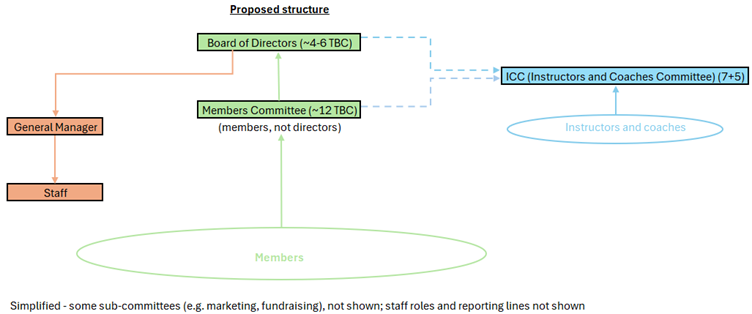
- Replace the Executive Committee with a new Members Committee and a separate Board of Directors.
- Divide the role of the current Executive Committee between these two bodies.
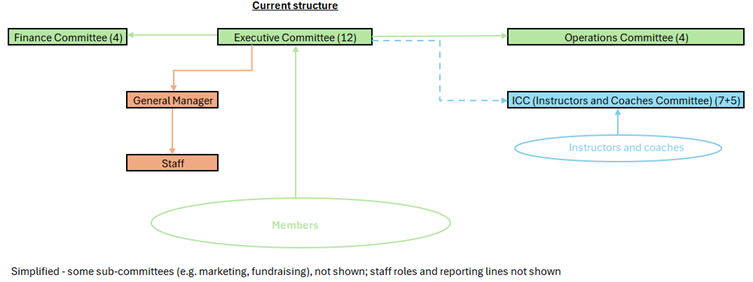
The follow diagrams illustrate (on a simplified basis) the current and proposed structures.
NOTE (A POINT OF CLARITY):
In this message, where I refer to the Board, that term presently means the Executive Committee – all current members of the Executive Committee are directors of the Club. Under the proposal, the Board will be distinct from any committee after the September 2026 AGM. If the proposal is approved at the AGM, we will then have a smaller Board and a new Members Committee.
Anticipated changes
- The Board will deal with financial, legal, compliance and risk management areas.
- The Members Committee will deal with membership representation, day-today operations, and promote members’ interests.
- We will change the Club’s articles to reflect the new governance structure.
- We will change relevant Club codes, policies and procedures to reflect the new governance structure – in particular, to refer appropriately to either the Board or the Members Committee.
Process
- The first Members Committee will be elected at the AGM in 2026.
- The first Board will be elected at the AGM in 2026.
- The existing articles (the Club’s constitution) will be replaced by new articles at the AGM in 2026.
- Relevant information will be circulated in advance so members can make an informed decision at the AGM.
Accountability
- At least one member of the Board must be a member of the Club.
- Members of the Committee will retire on a rotating basis (e.g. one third automatically up for re-election at each AGM) to strike a balance between refreshing the committee annually (in case new members wish to join) and maintaining continuity / stability.
- Elections for the Members Committee will take place annually at the AGM.
- In future years, the Board will not be elected by the membership. Changes will be decided by the Board itself (it will advertise for and interview candidates just as any other board might do).
- The Board will be required to make those appointments in the period before each AGM (absent exceptional circumstances).
- New appointments to the Board will require approval of at least 50% of the members attending the AGM. Without that approval the appointments will not be effective.
- If that results in the Board requiring additional members so it can function effectively, it will be entitled to appoint new directors. However, those appointments must first be approved by a majority of the Members Committee. (This is intended to prevent the Board being unable to fulfil its duties / placing an excessive burden on the remaining directors whilst, at the same time, ensuring the appointees are satisfactory to the Club’s members.)
- These positions (amongst others) will be enshrined in the new articles of association of the Club.
- Members will also be entitled to propose resolutions at each AGM (just as they can now) and to requisition an Extraordinary General Meeting (also, just as they can now).
- These measures are intended to operate as checks and balances. Through these mechanisms, members can ensure accountability and, ultimately (if the need arises), remain in control of their Club (by forcing through changes / taking preventative action where necessary), such as in cases where they perceive the Board not to be acting in the Club’s best interests. I repeat, I think this scenario is unlikely but want to reassure the members that the Club’s security and its members’ interests are paramount so we will hardwire these protections into the new structure.
Roles and relationship
- The Board will deal primarily with statutory and risk management matters in line with legal obligations (see “examples of responsibilities” below).
- The Members Committee will deal primarily with membership and customer experience matters.
- The Members Committee will escalate to or seek input from the Board where relevant.
- The Board will delegate or defer to the Members Committee where relevant.
- The two bodies will be mutually supportive and are expected to work together on some matters – for example, the Board may need to ask the Members Committee to consider something or to carry out certain tasks; the Members Committee may need to ask the Board to take certain steps / approve certain matters. In each case, it will depend on the nature of the matter at hand.
Members Committee – examples of responsibilities
- Governance – general oversight of Club operations and membership matters; act as an internal escalation point for everyday matters
- Site – building, car park, slope, playing field etc.
- Bar and catering (pricing**, range of offering, hours, service etc.)
- Events – organisation and planning etc.
- Assets – review, maintenance and replacement etc.
- New opportunities, new assets and growth initiatives etc.
- Snowsport England (in some respects)
- Code of conduct (in consultation with the Board)
- Timetable (led by the Instructors and Coaches Committee (ICC) but consulting the Members Committee)
- Minor contracts (supporting the General Manager / staff team)
- Day to day operational issues and the customer experience in general
- The committee (and General Manager / staff) will have delegated authority from the Board to approve and incur day to day expenses up to pre-agreed thresholds or within agreed parameters (e.g. ordinary course recurring costs that fluctuate monthly but fall within the budget)
** Budgeting and financial viability (profit/loss and revenue etc. will involve the Board.
Board – examples of responsibilities
- Governance – general oversight of compliance and risk; act as an internal escalation point for serious matters
- Compliance with law (e.g. health and safety, data protection, tax, accounts etc.)
- Finances (solvency, resilience/stability, budget, major spend etc)
- Health and safety etc.
- Other compliance (e.g. data protection)
- Employment (supporting the General Manager where required, including disciplinary matters, grievances, claims, pay reviews, PAYE, NIC and pension compliance)
- Risk management (e.g. insurance, risk register, risk assessments etc.)
- Safeguarding and welfare (policies and procedures etc; actual safeguarding matters will be channelled through the CWOs)
- Corporate compliance (e.g. Companies House filings, CASC status)
- Major contracts
- Landlord and lease
- Snowsport England (in some respects)
Reasons
Overview
- Directors have extensive statutory (i.e. legal) responsibilities. The role can also carry personal liability. These may not receive full attention if one is also required to focus on day-to-day operational matters.
- Confidential or sensitive operational matters (e.g. staff, safeguarding, health and safety, solvency concerns, legal claims) can be handled by a smaller group with greater discretion and more agility.
- Expecting a single group of volunteers to fulfil all aspects of the present role (statutory compliance plus operational performance of the Club) is not realistic or fair.
Detail
Operational efficiency and fairness
- 12 people on the Board is too many – it is unwieldy when it comes to governance and compliance matters.
- It is also not feasible for a group of volunteers to fulfil such diverse functions (on the one hand, day-to-day operational matters, on the other hand, governance and compliance oversight). The demands are too great. It places excessive pressure on those individuals, creating undue stress and (in some cases) impacting their personal and professional lives). That can lead to risk and liability for the individuals and the Club. It is also a disservice to the Club because it means that relevant areas may not receive the attention they deserve.
- We already have separate meetings of the Executive Committee and the Operations Committee (comprising four members of the Executive Committee) – i.e. the proposal to structure things on a more segregated basis is not such a huge departure from the status quo.
- However, it can be difficult to balance confidentiality, on the one hand, and accountability/transparency, on the other hand. Some things need to be handled confidentially by Ops. But there may also be an obligation to inform the other directors (full Exec) – e.g. if there are issues of legal liability etc, for which they may ultimately be responsible. That creates an inherent tension and adds workload.
- It is sometimes difficult to determine how situations should be handled: what information should be shared, with whom, when, and how.
- For example, 12 people should not be involved in all discussions relating to a sensitive staffing issue, a key health and safety matter, or a complex and sensitive legal matter. However, as directors, all members of the Executive Committee have responsibility for these matters so are entitled to be informed and to have a say (if not on every aspect, at least – arguably – on the major decisions). That poses real challenges for the Chairman, for the Operations Committee and for the General Manager. It is also not necessarily fair to the other members of the Executive Committee.
Burden and scope of responsibilities
- It is not realistic or reasonable to expect 12 volunteers to take on the responsibilities associated with being a director of the Club as well as having to deal with a myriad of operational decisions (albeit with a good staff team who carry out a great deal!). These include a mixture of statutory obligations and hands-on matters – see Roles and relationship (above).
- Training and guidance should be provided to the directors regarding some of the trickier legal responsibilities. That will come at a cost. Attendance will also require additional time commitment from directors. That can be more easily borne (by the Club and the individuals) and more simply coordinated if fewer people need to be supported in this way.
- Management of confidential matters is more difficult in a larger group.
- By freeing directors from some of the current day-to-day ‘burden’, they are better placed to fulfil their statutory duties and help the Club meet its legal obligations.
- Separating the Board from the Members Committee will allow us to focus on recruiting people to the Board with key skills to help the Club operate safely and sustainably.
- Members of the Management Committee will be freed from legal matters and more able to focus on improving and enhancing the customer experience, facilities and assets etc.
- Collectively, these and other changes should help the Club manage its risks more effectively, maximise opportunities and deliver a better experience for all on a more assured and confident basis.
Joining the Board in 2026
We very much need and want members to put themselves forward. Although there is quite a lot to digest in this message, the Club is actually in pretty good shape. In all these areas. But we want to be better and more thorough. So don’t be worried about biting off more than you can chew. It remains a voluntary role and expectations will be aligned with that!
We know there are many members at the Club with incredible skills and experience and a strong desire to help. Please reach out.
You may have run your own business or held a position of responsibility in a busy outfit, you may have been a consultant in a relevant area (e.g. law, accounting, health and safety, HR etc.), or you may already be (or previously have been) involved as a non-executive director or trustee of an organisation. If so, we need you!
We anticipate the following skills will be particularly useful on the Board. If you have expertise in any of these areas (and we do not expect you will be expert in all – even all under a single heading) please get in touch with Nick Watson to discuss the opportunity: moc.stropswonsklofronnull@namriahc / 07760 88 69 69.
- Finance – accounts, management accounts, business information and analysis, tax
- People and HR – managing staff (attracting, retaining and developing staff, disciplinary matters, grievances, absence management, performance management etc.), change management, policies and procedures
- Sales and growth – stakeholder management, fundraising, partnerships, sponsorship, commercial relationships
- Legal and compliance – data protection, health and safety, employment, safeguarding
- Operations – health and safety, risk management, insurance, property and asset management, volunteer-run organisations
The Club will look to provide relevant training to the Board in key areas and to secure external advice in all relevant situations where it may be necessary. Anyone considering a role on the Board should be comforted that we already have external lawyers, external accountants, external IT suppliers, an insurance broker, access to specialist legal advice under our insurance, and regularly use contractors for maintenance support. The Club also maintains insurance cover for its directors and officers.
Joining the Members Committee in 2026
There is lots to be done but it need not be too much – and the proposal will lessen the burden. We anticipate the following skills / interests will be useful on the Members Committee.
- Events and social
- Fundraising
- Maintenance
- Marketing, communications and social media
- IT and digital
- Project management and event organisation
The following areas will also be relevant – they may be represented on the Board but that does not necessarily mean there is not a useful role to be played on the Members Committee.
- Health and safety (e.g. liaison with the Board, General Manager and maintenance)
- HR (e.g. supporting the General Manager on internal matters such as candidate interviews, disciplinary matters etc.)
- Legal and compliance (including contracts, policies and procedures)
If you are considering whether you may want to get involved on the Members Committee, please get in touch with Nick Watson to discuss the opportunity: moc.stropswonsklofronnull@namriahc / 07760 88 69 69.
Organisational Structure – FAQs about the Proposal
I have tried to anticipate the sorts of questions members may have in response to the proposal. Some of these FAQs and the responses duplicate each other. That is because there may be a different emphasis for similar or overlapping questions. If you have any...
Current Volunteer Opportunities at Norfolk Snowsports Club
Become our Deputy Club Welfare Officer We’re looking for a caring, approachable volunteer to support the safeguarding of our members as a Deputy Club Welfare Officer. You’ll work alongside our Welfare Officer to help promote a safe, supportive environment for everyone...
Important Update: Snowsport England Membership Changes
Dear Members This email requires action on your part. We are sharing an update from Snowsport England (SE). I recommend you read the whole of this message but, if you are under time pressure, please scroll down to see what action you must take as members of Norfolk...
Freestyle at Norfolk Snowsports Club
Dear members This message relates to Freestyle but we are sharing it with everyone because who knows if you may be inspired to have a go. Freestyle is a lot of fun as well as being a great way to develop your skiing and boarding in other areas. This message...